
TL;DR
- Norman Gentsch joins Soilytix as Head of Agronomy, after 16 years as a soil scientist at Leibniz Universität Hannover.
- He moved from studying natural ecosystems to studying farmland for a specific reason: in a natural system you can record what is happening, in farmland you can change it.
- His research covers soil organic matter dynamics and carbon stabilisation under climate change, soil biology, sustainable soil management and biodiversity in agroecosystems, worked through cover crops, intercropping, agroforestry, organic amendments and tillage. [1]
- The job he describes is turning lab measurements into interpretations an advisor can act on, with statistics as the connective tissue.
- He met Bruno at a field day and found the idea of a soil biology start-up fascinating and very ambitious.
- He and our lead scientist Matthias Schaks have crossed paths before, on the EU intercropping project LEGUMINOSE, where Matthias did some of the data analysis.
- His description of the job starts with a hypothesis rather than with a sample.
- His aim is to improve the connection of soil and ecology data with taxonomy
- He also runs a market garden and sells the vegetables. He is a soil scientist who farms.
Interview by Cleiton Sena.
The sentence that explains the career
We asked Norman Gentsch to introduce himself, expecting a CV. What came out instead was the reason he changed direction halfway through his career.
"In natural ecosystems you can only document what's going wrong. But in agri-ecosystems you have the possibility to change things."
He had spent years studying soil organic matter in natural systems, asking how climate change was altering soil carbon budgets in different parts of the world and how that carbon stays put. Important work. Also work whose honest output is a record of what is happening, rather than a change in it.
Farmland is different. Someone makes decisions there every season. Which means research can change what happens next, rather than describe what already happened.
That is the instinct we hired.
From carbon to biology, then from forests to fields
Norman studied geography, geology and biology in Leipzig, then moved to Hannover, where he spent 16 years as a scientist in the soil science section at Leibniz Universität Hannover, in the working group of Professor Georg Guggenberger. [2]
His work moved through two turns.
The first was towards biology. He started in soil chemistry and organic matter dynamics, then followed the evidence:
"As we know that biology is one of the major drivers in soil and all biogeochemical cycles, we focused more and more on soil biology. And this became then my specific research field."
The second turn was towards agriculture, for the reason above. Since then the question has been consistent: how does plant diversity above ground change the biology below it, and how do you use that to manage soil better?
"How is plant biodiversity impacting sustainable soil management and soil biology, and how can we improve agrobiodiversity in these systems?"
The practical work that follows from that question covers most of the management practices a farm actually controls:
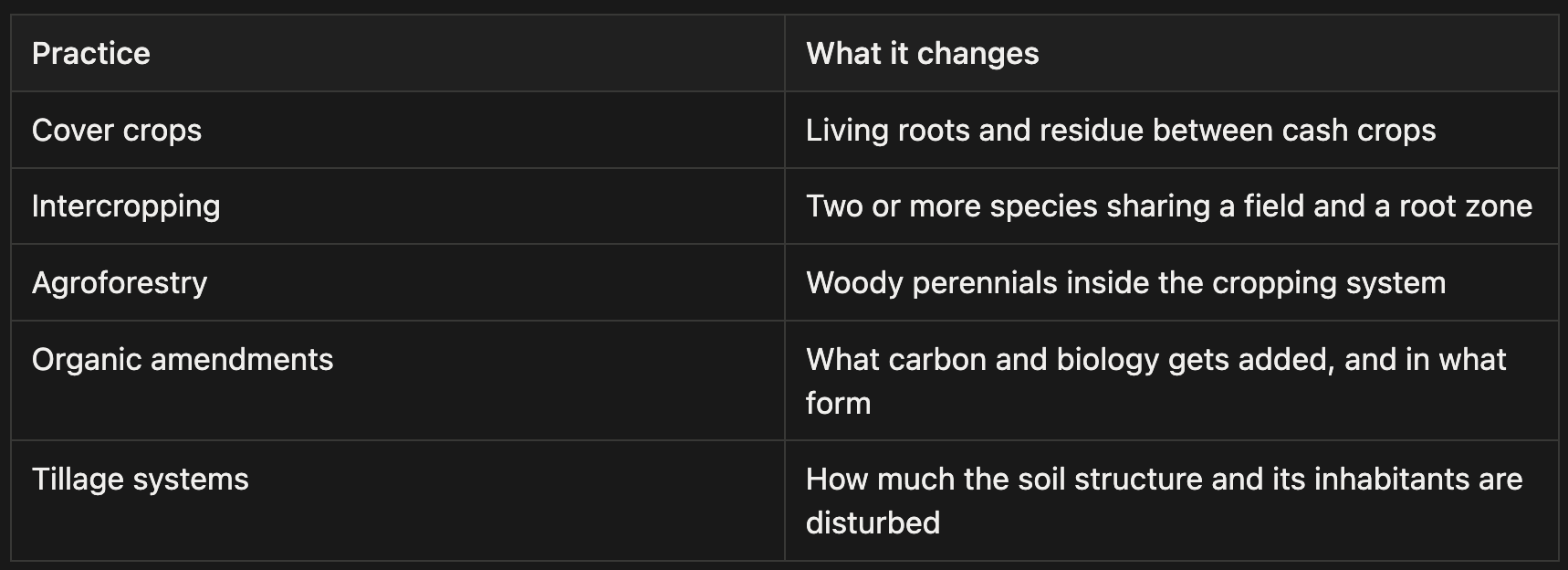
These are not separate interests. They are five ways of asking the same question about diversity and disturbance. His current and recent projects at Hannover include BonaRes-CATCHY, LEGUMINOSE, Klima Farming and smartMaN2agement, covering catch crops, intercropping and climate-oriented farming. [1]
He also explains this work outside the literature. There is a short talk of his on intercropping and biodiversity that is a better introduction to the thinking than any paper. [4]
What he expects the job to be
Norman's own description of the position, in his words:
“In Soilytix, I see new perspectives and new chances to improve the workflow and increase the potential impact on sustainable soil management. “
Two things in that list are worth pausing on. Publishing and dissemination are in the job description, which is unusual for a commercial role and says something about how the science is meant to be handled here. And recruiting scientific projects means the work is expected to keep earning its own funding through research consortia, not only through customers.
"I hope I can continue to make some impact in agronomy and for the environment of our planet. That's my basic aim."
Which is a modest way of describing the reason to make the move at all.
What a Head of Agronomy actually does here
This is the part worth reading twice, because it describes a gap that soil laboratories and advisory services often leave open between them.
Labs sell measurements. Farms and advisors need decisions. Between those two things sits a translation problem that nobody is formally responsible for, and Norman describes his job as sitting exactly there.
"Getting samples and getting data is one thing, but you need to read them, you need to interpret them, and you need to give conclusions based on statistics, based on the findings you have."
The dashboard is part of it, and he is clear that it is a good tool. He will use it. He also needs statistical tools beyond what a dashboard does.
"Statistics I use as a tool to connect the different compartments. So we have the soil by itself, we have the chemical and physical properties in soil, we have the soil biology with all the measurements we have."
The list he is connecting is longer than most soil reports acknowledge.
"We have the plants on the other side, which is the agronomy part. The plants impact the soil biology and also soil properties. Then we have the climate as well, the different locations, and management practices like pesticides or different tillage systems. All these informations must be connected to draw a proper conclusion on the research question the customer has."

What he is describing is differential diagnosis. A field underperforms. The cause could sit in any of those rows. Reading one layer at a time cannot tell you which. Reading them against each other, with enough observations and honest statistics, can start to.
It starts with a hypothesis, not with a sample
"The customers usually come with an idea or with a hypothesis, or even not. If not, then we need to think about what could be the hypothesis of that question."
He expects to do that with Julien.
"I would connect strongly with Julien, because he is acquiring the customers. We need to think what the customer needs, we need to select the tools we will need to answer the question, and finally we get the data, we evaluate them, and feed the information back into the model or the decision support systems."
Why this matters commercially, in our own words rather than his: a soil report that lists chemistry, physics and biology side by side is three reports stapled together. The value appears when those layers are read against each other and against a benchmark, and when the result is stated as a conclusion an agronomist can act on. That requires someone accountable for interpretation. Now we have one.
What he wants to be able to do in a year
We asked Norman to imagine a coffee twelve months from now, and to say what we would be celebrating. He did not answer with revenue or headcount.
"Not to select specific fields that are contaminated with specific pathogens. We could tell the customer, don't use this field, but you can go to other fields."
He points first at decision support tools already in development here, including field selection based on pathogen risk.
That is a small sentence describing a large shift. It moves a soil report from a description of a field to a decision about which field to plant. For a seed producer choosing trial sites, or a grower placing a susceptible crop, that is the difference between information and advice.
The second is the reference data behind soil health monitoring, and here he is careful.
"You have this reference dataset in the background with a lot of samples, and this is a kind of baseline for soil health monitoring. How can we use this data we have accumulated to give information about soil health, about healthy microbial communities?"
Note the plural. It is doing a lot of work, and Norman is firm about it:
There is no single healthy soil microbiome. Communities can look completely different in composition and still be healthy. The task is to identify key communities and networks that show signs of benefit for soil properties and plant growth.
So the sequence runs in a specific order, and skipping a step is how this goes wrong:
- Connect soil and ecology data with taxonomy.
- Understand what actually drives microbial taxonomy in a given soil.
- Only then attempt to say what healthy means, and for which soil type, crop and climate region.
- Work out how to steer microbial processes in the soil and in the rhizosphere.
- Turn that into management options someone can act on.
There is no score, and on his account there should not be one yet. What exists today is accumulated reference data and a defensible order of work.
Where that leads is the differential diagnosis from earlier:
"If there is a new sample coming in, we can already say, based on the measurements we have, this could be a problem of these or a problem of that."
The detail that tells you the most
Norman lives on a small farm in Saxony with his wife and two children. Next to the job, he runs a market garden: vegetables, grown and sold to a small group of customers.
"That's the part where I spend my free time."
It is easy to read that as a nice biographical footnote. It is not. A soil scientist who also has to produce a sellable crop has a different relationship with recommendations than one who does not. The cost of advice that sounds good on paper and fails in a field is something he pays personally, on weekends.
What this changes for customers
Three things follow from this appointment, and we would rather state them as intentions than as achievements.
- Interpretation becomes a named responsibility. Not a by-product of the lab, and not something each advisor improvises.
- Recommendations get a statistical standard. Conclusions drawn from noisy biological data need someone who knows when a difference is real and when it is not. That is a discipline before it is a deliverable.
- Agronomic practice enters the conversation earlier. Cover crops, intercropping, tillage and amendments are what customers actually control. Measurement that ignores them produces reports rather than decisions.
FAQ
Who is Norman Gentsch?
A soil scientist who spent 16 years at the Institute of Soil Science at Leibniz Universität Hannover, working on soil biology, geochemistry and agroecology, before joining Soilytix as Head of Agronomy. [2]
What does a Head of Agronomy do at a soil intelligence company?
Connects laboratory measurement to field decisions. That means interpreting chemical, physical and biological data together, applying statistical rigour to the conclusions, and making sure recommendations reach advisors in a form they can act on.
What is his research background?
Soil organic matter dynamics and carbon stabilisation under climate change, soil biology, sustainable soil management and biodiversity in agroecosystems. His applied work covers cover crops, intercropping, agroforestry, organic amendments and tillage. [1]
Is Soilytix launching a soil health score?
No. On Norman's account a score would be premature. The order of work is to connect soil and ecology data with taxonomy, understand what drives microbial communities, and only then attempt to define healthy for a given soil type, crop and climate region.
Why does agrobiodiversity matter for soil?
Because plant diversity above ground changes the biology below it. Different roots, residues and root exudates support different microbial communities, which in turn drive nutrient cycling and soil structure. It is one of the few levers a farm can pull without new inputs.
Sources
- Norman Gentsch, research profile, Leibniz Universität Hannover, Institute of Earth System Sciences, Section Soil Science. https://www.researchgate.net/profile/Norman-Gentsch
- Institute of Soil Science, Leibniz Universität Hannover. https://www.soil.uni-hannover.de/en/institute/people/
- "Preserving Biodiversity: Norman Gentsch on Intercropping", 6 minutes 30. https://www.youtube.com/watch?v=NASKaGxJ_b0