TL;DR
- UNCCD COP17 in Ulaanbaatar, Mongolia (17 to 28 August 2026) ran the first Food Systems and Soil Health Day in the history of the convention. Soil health went from an implied topic to a named one. [1]
- The private sector turned up in force, and the argument it made was economic. Healthy soil de-risks a supply chain.
- There are numbers behind that argument now. Up to 40 per cent of the world's land is degraded, costing an estimated USD 878 billion a year and directly affecting 3.2 billion people. Where returns have actually been measured at farm level they are real but context dependent: an integrated soil fertility trial in Western Kenya returned 3.2 dollars for every dollar invested. [7]
- The two constraints named most often were scale and standards. The science exists. A route from pilot plots to hundreds of thousands of hectares does not, and outcome data cannot be compared across sites without standardised protocols.
- The framing that carried the most weight across the two weeks was one health, which treats human, animal and environmental health as a single system. Soil sits underneath more of that system than its profile suggests.
- Land degradation and deforestation are one problem. When existing farmland produces less, the pressure to clear new land rises.
- Europe now has a law behind all of this. The Soil Monitoring and Resilience Directive (EU) 2025/2360 has been in force since 16 December 2025, and member states have until late 2028 to transpose it. [2][3]
Why we sent someone to a desertification COP
Soil rarely gets its own headline. It shows up inside food systems, inside climate, inside biodiversity, and it leaves the room before anyone writes it down as a commitment.
That changed in August. At the 17th Conference of the Parties to the UN Convention to Combat Desertification, held in Ulaanbaatar under the theme "Restoring Land. Restoring Hope.", the agenda carried a Food Systems and Soil Health Day. Not a side event. A named day, with a High-Level Ministerial Dialogue attached to it. [1]
Berenice Di Biase represented Soilytix. We called her afterwards and asked what actually happened, why she chose this event over everything else available, and what it changes for anyone who works with soil data. This is that conversation, organised.
What COP17 was

The UNCCD is the least famous of the three Rio Conventions. Climate has UNFCCC. Biodiversity has the CBD. Land degradation has the UNCCD, and it has historically drawn less attention and less money than either of its siblings. That is exactly why what happened on the agenda matters.
1. Soil health got named, and naming is not cosmetic
Berenice's first point was the one that sounds procedural and is not.
"For the first time at a COP, there was a soil health day. So before it used to be just food systems day. And this time, for the first time, it was Food Systems and Soil Health Day, which is really a huge step forward because it specifically puts the concept of soil health at the forefront of the dialogue on land degradation."
Agenda items are the unit of work at a COP. A named day gets a chair, a ministerial dialogue, prepared national positions, and a line in the reporting that follows. A topic that only lives inside another topic gets none of that. It gets mentioned.
The practical consequence arrives later, and somewhere else entirely. Language that appears on a UN agenda tends to migrate into corporate sustainability reporting, into procurement questionnaires, and into the questions a supplier gets asked in a tender. "Soil health" is now a term with an official venue behind it.
The day did not appear on the agenda by itself. Berenice traced it back to a specific piece of work, led by Andrea Meza Murillo, Deputy Executive Secretary of the UNCCD, who co-chairs the World Economic Forum's Global Future Council on Healthy Soils and Land with Professor Rattan Lal of Ohio State University. [8]
"The reason why we have the day at COP now of food systems and healthy soils is because of the work that was done by the UNCCD. She's the leader of this Global Future Council on soils group, which is the group that I'm part of, that published this World Economic Forum paper."
The group published The Hidden Economic Power of Healthy Soils with the World Economic Forum, developed together with the UNCCD. [7]
That paper is the economic argument underneath the agenda change, and it explains why the private sector engaged the way it did. Up to 40 per cent of the world's land is degraded, costing the global economy an estimated USD 878 billion a year and directly affecting 3.2 billion people. [7]
The paper does not stop at the global figure. It carries four case studies, and the one that speaks most directly to anyone working with soil data is Yara's NossoCafe coffee programme in Brazil. On Fazenda Santa Barbara in Minas Gerais, a 6.7 hectare management area inside a 63 hectare coffee farm was run under outcome-based monitoring from 2021 to 2023. Against a control, soil fertility attributes improved by 14 per cent, nitrogen use efficiency by 24 per cent, the coffee carbon footprint fell by 32 per cent, and the farm generated an additional R$8,307 per hectare. [7]
What made that possible was not a single practice. It was measuring soil across physical, chemical and biological indicators, on the same farm, over three seasons, against a control, and reporting soil outcomes and business outcomes inside one framework. The paper's own conclusion from its four cases is blunt on this point: measurement is what enables management, and ROI figures are meaningless unless you carry the practice, geography, crop and baseline along with them.
That is the argument of this post in one farm. The number that moved the business was not the soil measurement. It was what the measurement let someone manage.
So the sequence runs in one direction. A council builds the economic case, the UNCCD carries it into the convention, and the agenda gains a day. The paper and the day are the same piece of work at two stages.
2. The private sector showed up, and it talked about risk
COP17 was, in Berenice's account, one of the editions with the strongest private sector participation so far. Leaders from large agri and agri-tech companies were present, including major players across agriculture and agri-tech.
They were not there as observers. The position they were pushing is that soil health has to be accounted for inside their own operations and across their supply chains.
The framing is the part worth noticing:
"It was really good to see leaders from all sectors, ranging from agriculture to fashion, talking about how investing into healthy soils is key to de-risk their supply chains."
Fashion is in that sentence for a reason. Cotton, linen, wool and leather all sit on top of soil, several steps upstream of anything a consumer sees. The de-risking argument works even for a company with no interest in soil, because it is an argument about supply continuity.
The WEF paper puts a number on that exposure. When LVMH assessed its dependencies under the Taskforce on Nature-related Financial Disclosures, it found that 58.4 per cent of its raw material volumes depend on soil quality, soil formation and nutrient cycling, that more than 85 per cent of the agricultural land surface behind those materials is exposed to high soil-quality risk, and that more than 40 per cent of its soil-dependent raw materials already come from regions affected by soil degradation. [7]
The point of that assessment was not the disclosure. It was that the numbers named specific sourcing regions, from grapes in France and Argentina to cashmere in Mongolian rangelands, which is what turns an environmental dependency into something procurement can act on.
That changes who asks the question:
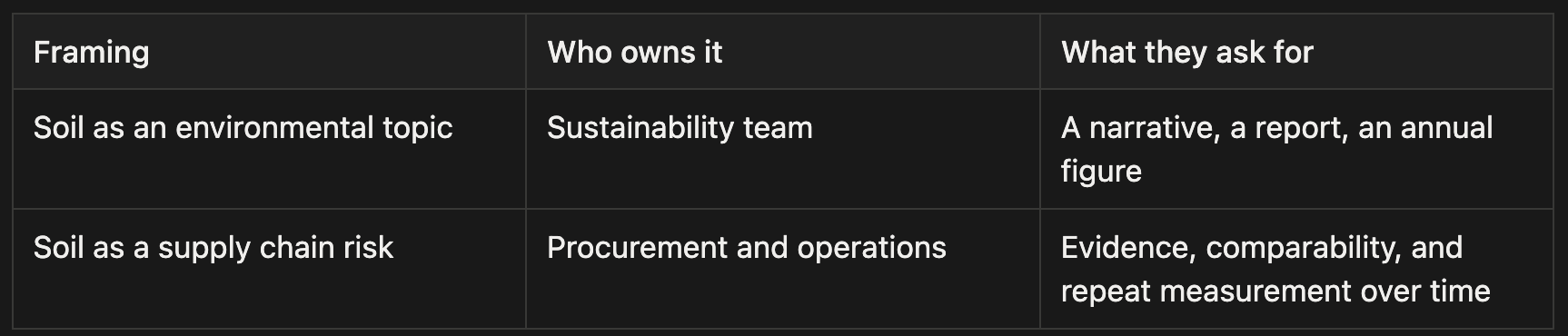
The second column is a very different customer from the first. It does not want a snapshot. It wants a baseline it can defend and re-measure.
3. Why a COP, and why this one
We asked Berenice directly: out of every event she could have attended, why this one.
Her answer was about the room, not the programme.
“COPs offer a unique setting to engage directly with both the public and private sector in the same room. Attendees include government executives, ministers of the environment from around the world, and business leaders across industries.
This mix of policymakers and industry decision-makers makes COP a venue worth attending on its own terms: it is one of the few places where regulatory direction and commercial priorities can be discussed face to face, in the same week, with the people who set them.”
Ministers and business leaders in one venue is genuinely hard to find. For Soilytix the value was understanding three things at once: how the public sector is shaping regulation, where private capability can realistically contribute, and where public-private cooperation on land degradation can actually be built rather than announced.
"I don't think there's many other opportunities like that at a global level."
4. The European clock is already running
There is also a reason this particular moment is worth the flight.
Europe now has its first law dedicated to soil. The Soil Monitoring and Resilience Directive (EU) 2025/2360 was adopted by the Council on 29 September 2025 and by the European Parliament on 23 October 2025, published in the Official Journal on 26 November 2025, and entered into force on 16 December 2025. Member states have three years to transpose it into national law. [2][3][4]
What the directive asks for, in plain terms:
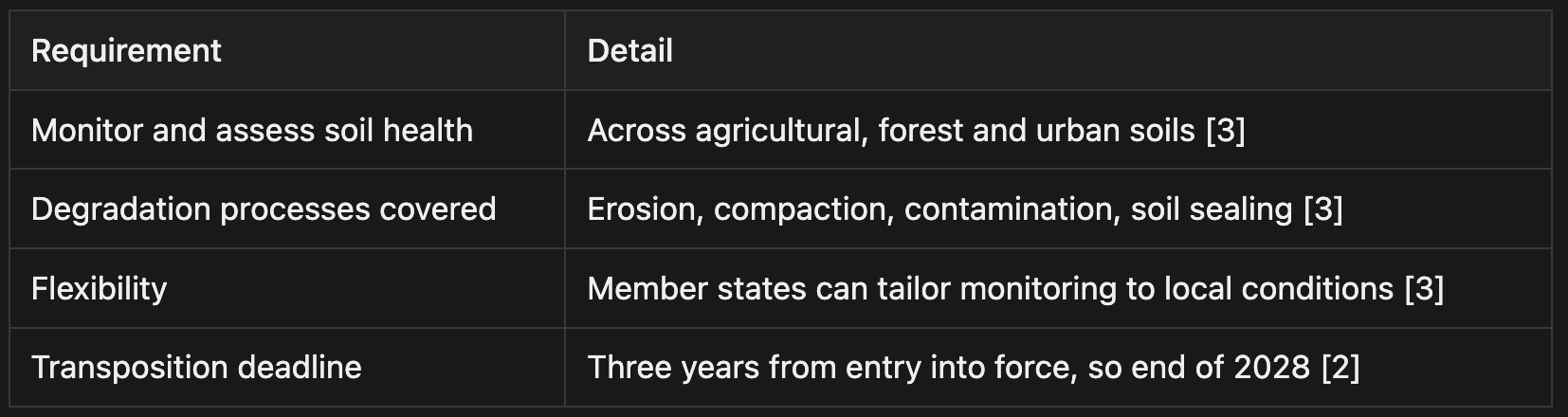
What she describes is a two-way process rather than a lobbying exercise. Governments are deciding what they will monitor. Industry has to be ready to supply it. Both sides move faster when they understand each other early, and the pace matters more than the positions.
"With the EU soil monitoring law approved, we're pushing soil health and land restoration forward in the political agenda. We must catch the momentum and understand what European governments are planning on monitoring and what solutions will be rolled out to comply with the EU soil monitoring law. And are getting prepared for that and assessing how we can best serve them and collaborate."
The wider point she made about COPs applies directly here. The reason to be in the room is to work out where the two sides meet:
"How the public sector is shaping regulation, how businesses can play a role to help, and how we can create public-private synergies to work towards resolving the issue of land degradation together as quickly and as best as possible."
"As quickly as possible" is the part that should not be skipped. Regulation sets a floor and a deadline. It does not, on its own, accelerate restoration. Acceleration comes from the public and private sides agreeing early on what will be measured, who measures it, and what counts as proof, so that compliance work and restoration work are the same work rather than two parallel efforts.
A monitoring obligation also behaves differently from a testing obligation, and this applies to everyone in the chain. Monitoring means the same place, measured the same way, compared across years and across regions. The weight falls on protocol consistency, sample provenance and benchmark quality rather than on any single clever measurement. A one-off soil test cannot satisfy a directive built around change over time.
5. What is actually blocking people: scale and standards
We asked what challenges people shared with her. The answer came fast, and it was not about science.
"Scalability is the main challenge across both public and private, because we do have a lot of scientific data. We have plenty of solutions that can be implemented. The problem is that we're not yet able to scale from the small pilot level to rolling out to the hundreds of thousands of hectares that we need to restore."
Knowledge is not the constraint. Restoration practice is reasonably well understood at plot scale. What is missing is a way to run it, and to verify it, across an area large enough to matter.
The second constraint follows directly from the first:
"Another challenge is standardization. When it comes to data collection and data interpretation, we need to interpret outcome data in a way that is comparable, but it's hard to do that if we don't have standardized protocols on how to do that."
Put the two together and the shape of the problem is clear:

Standards are the quieter of the two and, for anyone who works with data, the more consequential. Outcome data that cannot be compared is not evidence. It is an anecdote with a number attached. Two projects can both report improvement while measuring different things, at different depths, in different seasons, against different baselines.
"Really, the key word is scaling. We do have some solutions. We have to start somewhere. We don't know how to scale yet, to the level that we need to in order to restore enough land to meet the objectives that we set as a global community."
6. Where we think we can help, and where we are still working
We asked Berenice where Soilytix fits against those constraints. Her answer starts with the cost of measurement itself.
"Part of the scaling problem, at least of monitoring soil health, is the fact that it's very labor intensive and it can be expensive to do soil sampling and testing."
That is the honest bottleneck. If monitoring one hectare costs what it currently costs, monitoring hundreds of thousands of hectares is arithmetic that does not work. The directive in section 4 sharpens this, because a monitoring obligation is recurring by definition.
What we are doing about it, in her words:
"We're currently working on incorporating as much satellite and Earth observation layers as we can to optimize our sampling strategy. And we are, as Soilytix, doing this within agriculture, and with STRATERRA we are doing this within forestry."
"A key part of monitoring and scaling the monitoring of soil health is having an economically and logistically feasible sampling strategy."
STRATERRA is the forestry side of that work. It is a joint effort between Soilytix and TransparenC, developed under the European Space Agency's SOCBIO-MAP research programme, with Forest Stewardship Council Chile as lead pilot partner. It combines satellite layers (Sentinel-2 optical, Sentinel-1 radar, GEDI canopy height and a 30 metre elevation model) with field samples analysed for physicochemical properties and microbial eDNA, and produces wall-to-wall estimates of soil organic carbon stocks, below-ground biomass and biodiversity indicators for forest carbon projects. It replaces conventional grid sampling with a field campaign designed around what the satellite data already shows.
To be precise about status: that is a research programme with a lead pilot rather than a finished product. The idea is simple to state and hard to execute. Satellite and Earth observation layers do not replace soil samples, because the things that matter most in soil biology are not visible from orbit. What those layers can do is indicate where to sample. If environmental context is used to stratify a landscape sensibly, the same budget buys a more representative picture, or the same picture costs less.
We are not alone in that read, and it is worth saying that we are following a direction the field has already set rather than inventing one. The WEF paper devotes a box to exactly this shift. It describes the Land Degradation Surveillance Framework, now running with partners in more than 45 countries, which pairs statistically robust field sampling with standardised protocols to produce comparable georeferenced data. It describes soil spectroscopy, where one calibrated scan predicts several soil properties at a fraction of conventional laboratory cost. And it describes the combination of the two with satellite Earth observation, where field measurements supply the ground truth and satellite imagery supplies continuous spatial coverage, so that predictive maps can extend beyond the sampling points. [7]
The same box carries the caveat we would want attached to our own work. Different decisions need different precision. A 30 metre satellite pixel can be adequate for national monitoring and close to useless to a smallholder managing one or two acres. The challenge, in the paper's words, is not generating more soil data but building evidence systems that are trusted, affordable and appropriate to the decision they serve.
That is the lever we think is real: sampling design rather than sampling volume. It addresses the cost side of the scale problem, and it is worth something only if the protocol behind it stays consistent enough for results to be compared later. Which returns to the second constraint Berenice named, and that is the one we take most seriously.
"Earth observation helps us design smarter sampling strategies by showing where conditions vary across a landscape, so field samples can be placed where they provide the most representative evidence. It does not replace soil sampling or directly measure soil biology; it helps us use fieldwork more efficiently while maintaining a consistent, defensible protocol." Maurice, CTO Soilytix
7. One health: soil sits under more of the system than it gets credit for
The framing that came up most across the two weeks was one health: the approach that treats human, animal and environmental health as a single system rather than three separate ones.
"A constant in the conversation is that of course from soil comes our food. High quality food means a healthy diet, which translates into improved human health. There was a big emphasis on the one health approach and the importance of soils for human health, animal health, and also how soils link the atmosphere and the hydrosphere. It's all completely connected."
Soil sits underneath more of that system than its public profile suggests. It stores carbon, which connects it to the atmosphere and makes it a climate lever. It filters and holds water, which connects it to the hydrosphere. It produces food, which connects it to diet and to human health.
Pollution travels those same pathways in the other direction, and she was explicit about the route:
"Water contamination through what we put in the soil. And again, pollution ties back to human health, animal health."
One health also does something useful in political terms. It gives soil a claim on health language and health budgets, not only agricultural ones.
8. Why degradation shows up as deforestation
Deforestation is one strand of that same system, and it was the connection Berenice found most immediately useful.
"Land degradation and the lower agricultural productivity that we're seeing across the world because of climate change is directly linked to deforestation. With agricultural land is becoming less productive due to mismanagement and climate change, the demand for deforestation obviously rises. The two are connected."
The logic is uncomfortable and simple. Land that yields less does not reduce demand. It moves demand somewhere else, and the somewhere else is usually forest.
Which means productivity on existing farmland is a deforestation lever, not a separate conversation. Keeping soil functional where agriculture already happens is one of the cheaper ways to reduce pressure to clear land that is currently standing.
"That's another reason why we need to take land degradation as a key issue that links climate change and, in general, the health of both our planet and people."
9. What she took away, and what comes next
We asked her to summarise the two weeks.
"It was really good to see the global community, both from a public and a private sector level, coming together and agreeing really that we need to step up and we need to do it now if we want to restore land and soils."
On what happens next, she named three things in order.
Convert momentum into working relationships.
"The next step is understanding how we can take this momentum and these synergies between public and private, but also between different private sector parties, so that we can do this as efficiently and as quickly as possible."
The phrase worth noticing is "between different private sector parties". Public-private cooperation gets the attention, but companies in the same supply chain measuring soil in incompatible ways is a problem the public sector cannot solve for them.
Unlock finance. This was one of the two themes she said came up repeatedly across the two weeks.
"Nobody is shying away from the importance of needing to unlock finance to implement the solutions that we need to restore land and keep ourselves healthy."
That is a change in register. Restoration finance used to be raised as the awkward question after the science. At COP17 it was stated as the constraint it is, the WEF paper maps the financing ecosystem that would have to exist for it: grant and philanthropic capital to prove concepts, blended and concessional finance to de-risk them, and institutional capital to make natural capital a recognised investment category. Its worked examples run from a public programme reaching 784,500 farmers in Ethiopia to a fund with USD 208 million under management. [7]
Roll out at scale, without assuming one model fits everywhere.
"We need to take care of the fact that different geographies have different needs, different countries have different economic possibilities."
That last point cuts against the instinct to standardise everything. Practice has to vary by geography and by what a country can afford. Measurement is where consistency has to hold, so that results from places that farm differently can still be compared.
What we are taking from COP17
- Soil health is now named. It has its own day at a UN COP, and that day traces back to the UNCCD and the Global Future Council on Healthy Soils and Land work behind the WEF paper. Expect the term to spread into corporate reporting and supplier questions.
- The buyer is changing. The de-risking argument moves soil out of the sustainability report and into procurement and operations decisions. The LVMH figure, 58.4 per cent of raw material volumes dependent on soil, is the kind of number that moves it there. [7]
- The bottleneck is scale and standards. Nobody at COP17 was asking for more proof that soil matters. They were asking how to run restoration over large areas and how to compare the results.
- Standardisation is the constraint we can act on. Comparable outcome data requires consistent protocols and traceable sampling. That is a discipline problem before it is a technology problem.
- The EU directive sets the clock. The question is no longer whether to measure soil. It is what gets measured, how often, and to what standard, with a 2028 transposition deadline behind it.
- One health gives soil a wider claim. Soil connects to food, to water, to the atmosphere and to human health, which puts it in budgets and conversations that are not agricultural.
- Degradation and deforestation are one problem. Productivity on existing farmland belongs in the forest conversation.
FAQ
What is UNCCD COP17?
The 17th Conference of the Parties to the UN Convention to Combat Desertification, held in Ulaanbaatar, Mongolia, from 17 to 28 August 2026 under the theme "Restoring Land. Restoring Hope." The UNCCD is the UN convention dealing with desertification, land degradation and drought. [1]
What was the Food Systems and Soil Health Day?
A thematic day held on 27 August 2026, including a High-Level Ministerial Dialogue. It was the first time a COP agenda named soil health rather than treating it as a component of food systems. [1]
What is the economic cost of soil degradation?
Up to 40 per cent of the world's land is degraded, costing the global economy an estimated USD 878 billion a year and directly affecting 3.2 billion people. Returns on restoration are real but context dependent. In an integrated soil fertility trial in Western Kenya documented in the WEF paper, every dollar invested returned 3.2 dollars, with yields of 5.4 tonnes per hectare against 2.7 in the control. Any single ROI figure should be read with its practice, geography, crop and baseline attached. [7]
What are the main barriers to land restoration at scale?
Two came up repeatedly at COP17. Scalability, meaning the gap between solutions proven on pilot plots and the hundreds of thousands of hectares that need restoring. And standardisation, meaning the absence of agreed protocols for collecting and interpreting outcome data, without which results cannot be compared across sites.
Why does standardised soil data matter?
Because outcome data that cannot be compared cannot be used as evidence. Two projects can both report improvement while measuring different things, at different depths, in different seasons, against different baselines. Monitoring obligations assume comparability over time, which only holds if the protocol holds.
What is the one health approach?
The approach that treats human, animal and environmental health as a single system rather than three separate ones. Applied to soil, it connects soil to food and diet, to water quality, to carbon in the atmosphere, and through pollution back to human and animal health.
When does the EU Soil Monitoring Law apply?
Directive (EU) 2025/2360 entered into force on 16 December 2025. Member states have three years to transpose it into national law, which puts the practical deadline at the end of 2028. [2][3]
What does the EU Soil Monitoring Law require countries to measure?
Member states must monitor and assess soil health across agricultural, forest and urban soils, covering degradation processes including erosion, compaction, contamination and soil sealing, with room to tailor monitoring to local conditions. [3]
How is land degradation connected to deforestation?
When existing agricultural land becomes less productive, demand does not fall, it relocates. The pressure to bring new land into production rises, and that new land is often forest. Maintaining productivity on existing farmland therefore reduces pressure to clear forest.
Why does a soil intelligence company attend a policy conference?
Because monitoring obligations are written by governments and absorbed by companies. Being present is how you learn what will be required, early enough to build measurement that satisfies it.
Sources
- Coalition of Action 4 Soil Health, "Soil Health Takes Centre Stage at COP17: A Landmark Food Systems and Soil Health Day". https://www.coalitionforsoilhealth.org/news/soil-health-takes-centre-stage-at-cop17-a-landmark-food-systems-and-soil-health-day
- Council of the EU, "Council adopts new rules for healthier and more resilient European soils", 29 September 2025. https://www.consilium.europa.eu/en/press/press-releases/2025/09/29/council-adopts-new-rules-for-healthier-and-more-resilient-european-soils/
- European Commission, "First EU law on soil set to enter into force", 5 December 2025. https://environment.ec.europa.eu/news/first-eu-law-soil-set-enter-force-2025-12-05_en
- EU Mission Soil Platform, "The Soil Monitoring Law is published in the EU Official Journal". https://mission-soil-platform.ec.europa.eu/news-events/latest-news/soil-monitoring-law-published-eu-official-journal
- UNCCD COP17 official site. https://unccdcop17.org/?lang=en
- World Economic Forum, in collaboration with the Global Future Council on Healthy Soils and Land, The Hidden Economic Power of Healthy Soils, White Paper, August 2026. PDF | Landing page
- UNCCD, Andrea Meza Murillo, Deputy Executive Secretary. https://www.unccd.int/convention/who-is-who/unccd-staff/andrea-meza-murillo
- Coalition of Action 4 Soil Health, "New World Economic Forum Global Future Council on Soils Advances Global Soil Agenda". https://www.coalitionforsoilhealth.org/news/new-world-economic-forum-global-future-council-on-soils-advances-global-soil-agenda
- STRATERRA. https://straterra.earth/