
TL;DR
- Ten soil samples in Wayana territory, southeast Suriname. Five on abandoned goldmine sites, five in rainforest a short walk away. Same area, same week, same lab.
- Three of the five mine samples held no measurable soil DNA at all. The mine group averaged 61% less than the forest.
- The forest soil held about 550 fungal species, above what typical farmland carries. On the mine, close to none.
- What is missing on the mine are the slow species: acid-loving bacteria that live off leaf litter, and predatory nematodes at the top of the soil food web. Both take years to establish.
- One organism appeared on the mine and in no forest sample: a metal-tolerant bacterium that turns dissolved gold into solid particles.
- The practical consequence: replanting a forest assumes there is living soil to plant into.
Report by the Mulokot Foundation and Echo Echo. Soil analysis by Soilytix, coordinated via WildWildEarth. Sampling November 2025, report issued August 2026.
A handful of earth, and what is in it
"If you pick up a handful of earth in the forest, it is full of life. At the goldmine sites it feels like dust."
That is André Verhoogt, managing director of Stichting Mulokot, speaking to the Suriname Herald in March. [2]
He is describing something anyone who has held both can feel. The question the Mulokot Foundation and Echo Echo wanted answered was whether it could be measured, and by how much.
It can. Every living thing leaves DNA behind in the soil. You cannot see bacteria, fungi and the very small animals that hold soil together, feed trees and keep water clean, but you can extract their DNA from a sample and count what is there.
Where this was done, and what happens there
The sampling took place along the Lawa river in southeast Suriname, near Maripasoula, in Wayana territory. The Mulokot Foundation was founded by Paramount Chief Ipomadi Pelenapin as the legal and executive arm of the Wayana village leaders, which matters for how this work should be read: the community commissioned the measurement of its own land.
Small-scale gold mining there works the ground itself. Trees are cleared. The topsoil is stripped. The layer beneath is washed out with high-pressure water into a pit, and the sand and gravel are run over sluices. Mercury is used to bind the gold before being burned off.
What stays behind is a crater of bare, waterlogged spoil. No leaf litter, no root network, no shade, and metals left in the ground and in the run-off that reaches the creeks.
The Wayana depend on subsistence farming and river fishing. The forest, in the Herald's phrasing, is their supermarket, their pharmacy and their culture. [2]
How it was tested
Ten samples, taken over two days in November 2025. Five on abandoned goldmine sites, five in intact rainforest nearby.
The mine sites and the forest plots lie within a short walk of one another. Same soil type, same climate, same rainfall, same week, same laboratory. The only variable that differs is what has happened on the surface.
Ten samples is a small study. Placed like this, it is enough to see whether a difference is real.
How much life is left
Soil DNA per sample, in nanograms per microlitre:
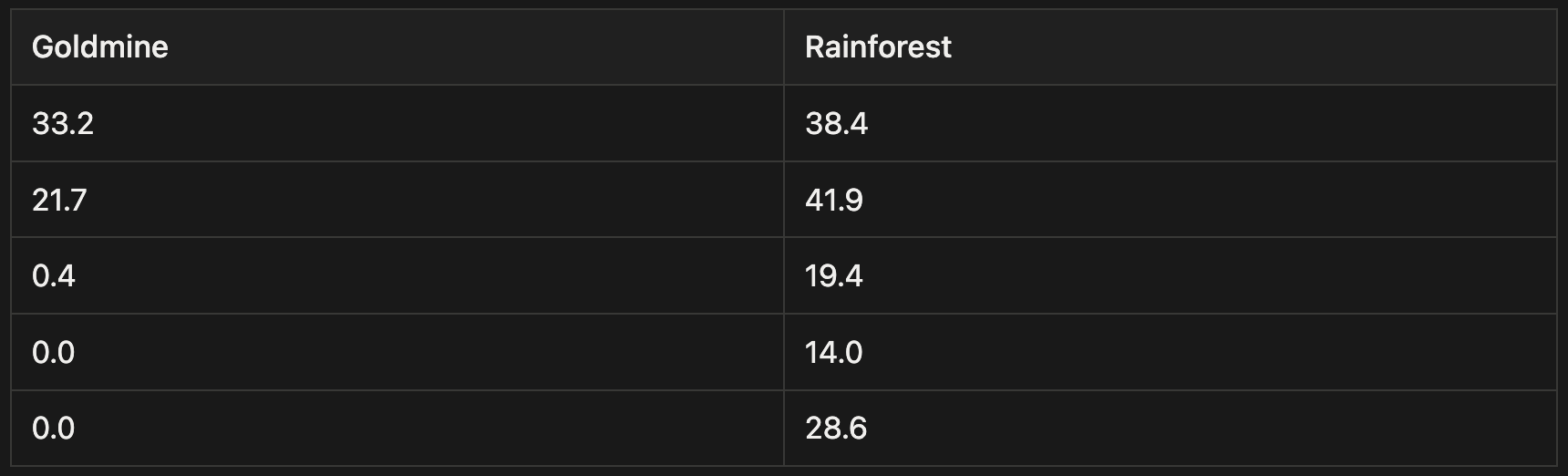
The five forest samples are strong and consistent, averaging 28.4. The mine group averages 11.0, and on the three bare sites it averages 0.1.
A reading of 0.0 means the instrument could not detect DNA. In plain terms, next to no microbial life.
Fungi tell the same story more sharply. The forest soil carried around 550 species. Typical farmland sits between 200 and 400. On the mine, three of five samples yielded too little DNA to read fungi at all, and the two that did read stayed in single figures.
The canopy is doing the work
Goldmine 1 and 2 read 33.2 and 21.7, close to forest values. That looks like a contradiction until you see where they were.
Both were pits worked inside a gap in the forest, with the canopy still closed around them. Shade, falling leaves and roots at the edge keep feeding that soil. Goldmine 3, 4 and 5 were bare, cleared ground with no canopy left, and that is where the readings collapse.
The digging is not what empties the soil. The clearing is. Leaf litter, shade and edge roots keep feeding soil even where the ground has been dug. Remove the canopy and that supply stops. The gap between a pit inside forest and a bare cleared site is as wide as the gap between mine and forest overall.
Which tells you where restoration has to start.
Who is missing
Total DNA says how much life is left. The species tell you which kind.

Forest soil runs on patience. The species in that first row get by on very little and take years to establish. Predatory nematodes sit at the top of the soil food web and only occur where the ground has been left alone for a long time. They are slow to come back after damage, which is exactly why their absence is informative.
What is left on the mine is the fast, tolerant end of soil life.
The organism that only appeared on the mine
One name in that table is worth its own section.
Cupriavidus metallidurans is known for two things. It survives concentrations of copper, lead, cadmium and mercury that kill almost everything else. And it takes dissolved, toxic gold and turns it into solid gold particles. It is, in plain language, a bacterium that makes gold, and it is one of the ways gold nuggets form in nature.
It was found in one mine sample, at 0.06% of the community, and in none of the five forest samples.
It is a fingerprint of a place where metals, rather than leaf litter, decide who survives. One sample, so a strong signal rather than proof.
It also points somewhere useful. Close relatives of this bacterium are already used to clean mercury out of polluted farmland. An early lead for restoration work on this ground, not a solution.
Why this matters beyond one river
Across southern Suriname, pollution from gold mining is a direct threat to clean drinking water. What this study measured is the same problem one step earlier, in the ground itself, before it reaches the creeks.
And it puts a number on something that changes how restoration should be planned. Forest soil here is rich and stable. Bare mine soil is biologically close to empty. That is why water runs dirty, and why forest does not grow back on its own.
Reforestation programmes are usually costed in seedlings. This suggests that on cleared mine ground the binding constraint is not the planting, it is whether there is living soil for anything to grow into.
What we cannot say yet
Six things limit how far these results can be pushed, and they are worth stating before anyone quotes the headline number.
- Two different kinds of mine site. Goldmine 1 and 2 sat in a forest gap with leaf litter still present. Sites 3, 4 and 5 were bare cleared ground. One label, two very different situations.
- Cooling was hard to keep constant. Boat, plane and city storage before the lab. Temperature swings can lower a DNA reading, so degraded soil is not the only possible explanation.
- 0.0 is a limit, not a zero. It means below what the instrument can detect, not proof that no DNA is present.
- Species names are thin. Only 0.3 to 3.2% of the bacterial DNA could be named to species level with the technology used. The gold-making bacterium sits in that thin layer.
- The small animals were pooled. For nematodes the lab combined samples per group, so those differences illustrate a pattern but cannot be tested statistically.
- Ten samples is a first look. Enough to see a pattern this large, not enough to prove it.
What comes next, and what we are looking for
Ten samples show a pattern. Three things would turn it into evidence.
Mines of different ages. Sites abandoned 0, 2, 5, 10 and around 50 years ago, each with forest beside it, to see whether and how fast soil life returns.
More samples per site. Enough repeats per location to test the differences properly, with forest-gap and bare mine sites kept apart rather than averaged together.
Use it for replanting. Which soil treatments help forest return on old mine ground, and how to track progress over time.
None of that is work one lab or one foundation does alone. We are looking for partners to scale this, whether that is funding, field capacity, or restoration programmes that need a way to measure whether the ground is recovering.
Mulokot and Echo Echo continue to work on the ground in Wayana territory. [2]
Why we were involved
Soilytix works mostly in agriculture and forestry. This is neither.
We did the analysis because eDNA answers this kind of question well. You cannot argue with a community about whether their soil is dying. You can measure it, and hand them the number.
That is the argument for measuring soil biology, in one sentence. It turns something a community already lives with into something that can be shown to other people.
FAQ
What was measured?
Total soil DNA per sample, and which bacteria, fungi and small animals are present, from ten soil samples taken in November 2025.
Does 0.0 mean there is no life in that soil?
No. It means the amount of DNA was below what the instrument could detect. It indicates next to no microbial life rather than proving none.
Why only ten samples?
It was a first look. The report is explicit that ten samples are enough to see a pattern this large and not enough to prove it, and it proposes more samples per site as the next step.
Did you measure mercury?
No. Mercury is used in the mining process described here, and the Suriname Herald reports mercury and cyanide residues in the rivers. This study measured soil DNA, not metals.
Why does losing the canopy matter so much?
Because leaf litter, shade and roots are what feed soil biology. The two mine samples that still held DNA were pits inside a forest gap with the canopy closed around them. The bare sites, without that input, are where the readings collapse.
What does this mean for reforestation?
That soil condition should be assessed before replanting is costed. On bare mine ground the biological base that a young forest depends on is largely absent.
Sources
- Ground Zero: what happens to the life in the soil when rainforest becomes a goldmine, Soil Report P0029, Mulokot Foundation, Echo Echo and Soilytix. Sampling November 2025, report issued August 2026.
- André Verhoogt in Suriname Herald, 4 March 2026. https://www.srherald.com/suriname/2026/03/04/bodem-bij-goudmijnen-biologisch-dood-je-kunt-hier-niets-meer-planten/
- Echo Echo Foundation, LinkedIn. https://www.linkedin.com/feed/update/urn:li:activity:7495751647462199297/