TL;DR
- We will be at Norrsken Impact Week in Barcelona on 14 and 15 October, both days.
- Norrsken was founded in 2016 by a Klarna co-founder and now runs five funds, five houses and over 750 million euros backing more than 150 startups.
- The room is founders and investors rather than agronomists, which is unusual for us and deliberate.
- The economics of soil are no longer in dispute. Up to 40% of the world's land is degraded, costing an estimated USD 878 billion a year, and restoration returns an estimated 7 to 30 dollars per dollar spent.
- What is missing is not appetite. It is the ability to measure the same thing the same way twice, which is what any financeable outcome requires.
- That gap is the thing we build, and it is what we are going there to talk about.
Norrsken
Norrsken Foundation was set up in June 2016 by Niklas Adalberth, one of the co-founders of Klarna, with an initial 20 million dollars of his own money, followed by another 62 million in December 2017. [1]
It is a non-profit impact investor. The stated purpose is to back companies working on problems including poverty, famine, mental health, pollution and climate change.
It has grown into three things at once.
Funds. Norrsken VC launched in 2019 with 100 million euros. Norrsken22 followed in 2021 with 200 million dollars for African early-stage tech. Norrsken VC Fund II closed in 2024 at 320 million euros and has been described as Europe's largest early-stage generalist impact fund. By the end of 2024 the group had raised over 750 million euros and backed more than 150 startups. [1]
Houses. Physical hubs for founders and funders, in Stockholm, Barcelona, Kigali, Brussels and Amsterdam. Stockholm opened in 2017 in a converted tram depot. Kigali opened in December 2021 at 12,000 square metres. Barcelona opened in October 2023. Across all of them, more than 3,000 members. [1][2]
Initiatives. Programmes and events, of which Impact Week is one.
That combination is the reason the event is worth two days. The people in the room are not only there to listen, they are there with mandates.
Norrsken Impact Week
14 and 15 October 2026, Norrsken House Barcelona. [2]
Two days built around startups solving climate, health and social problems, and the funds that back them. Around it, Barcelona4Impact runs community side events across the city from 13 to 16 October.
It is not an agricultural event and it is not a soil event. It is a room where capital and founders meet, which is a room a soil company does not usually walk into.
Previous editions
Impact Week is not new. The 2024 edition ran on 6 and 7 November, also at Norrsken House Barcelona, and the format has been consistent since Barcelona House opened in October 2023.
Norrsken also runs a separate, investor-only event called Impact/Return. Its fourth edition took place at Norrsken House Barcelona in 2025 and drew more than 300 investors across four stages with over 50 speakers. Worth knowing the difference: Impact/Return is capital talking to capital, Impact Week is capital meeting founders.
Who is joining the Norrsken Impact Week
The audience is founders, investors covering venture capital, private equity and limited partners, operators, and people who build the infrastructure around startups. Financial institutions including BlackRock, Morgan Stanley, UBS and Goldman Sachs have attended previously. [2]
The 2026 speaker list gives a sense of the range:
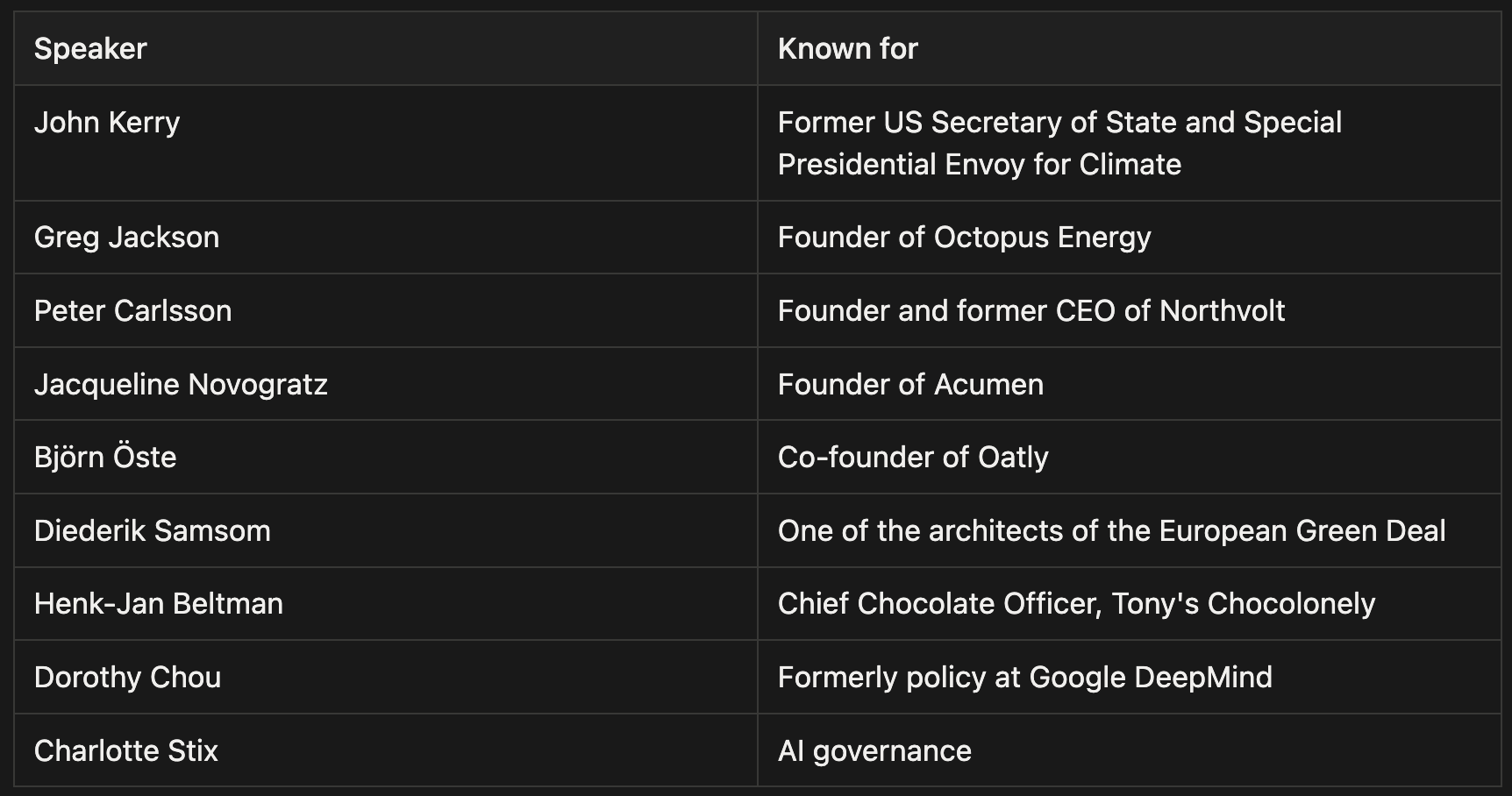
Energy, food systems, AI governance, capital and policy, in the same building. Soil sits underneath at least three of those and is rarely in the conversation.
Why we are going there
Most of our year is spent with agronomists, seed breeders and soil scientists. Those are the people who use what we produce.
We are going to Barcelona because that room decides where capital goes, and because soil has a problem that capital is unusually well placed to fix.
The case for soil has already been made
And largely by other people.
The World Economic Forum's work on soil, developed with the UN Convention to Combat Desertification, put numbers on it. Up to 40% of the world's land is degraded. The cost to the global economy is estimated at USD 878 billion a year. Restoration returns an estimated 7 to 30 dollars for every dollar spent, through yield, carbon storage and resilience.
And the exposure is not abstract. When LVMH assessed its own dependencies, it found that 58.4% of its raw material volumes depend on soil quality, soil formation and nutrient cycling. That is a luxury group, several steps removed from a field, discovering that most of what it sells starts in soil.
We are not going to Barcelona to repeat that case. It has been made, and made by people with more standing on it than us.
The step that keeps getting skipped
It sits between the case and the cheque.
Financing anything requires a number that holds still. An insurer needs a baseline. A buyer of a restoration outcome needs to know the ground improved rather than that the weather was kinder. An investor doing diligence needs the second measurement to be comparable with the first.
Soil data today mostly fails that test. It is produced as one-off snapshots, by methods that vary between laboratories, without a baseline to compare against, and often without enough provenance to reconstruct how the sample was taken. Two reports can both say the soil improved and mean different things by it, measured differently, at different depths, in different seasons.
That is not a scientific failure. It is an infrastructure gap. The science of measuring soil biology works. What does not yet exist at scale is the boring layer underneath it: consistent protocols, traceable sampling, and benchmarks good enough to turn a number into a judgement.
So the argument we are bringing is that soil is close to being financeable and is not there yet, and the gap is measurement rather than awareness.
What "measurable twice" actually requires
Four things, none of them glamorous.
A baseline. Change is only meaningful against a starting point. A restoration claim without a defensible baseline is an assertion.
Protocol consistency. The same depth, the same season, the same extraction, the same pipeline. Change the method and you have measured your method rather than the soil.
Provenance. Where the sample came from, when, who took it, and under what conditions. Without it a result cannot be audited, and anything that cannot be audited cannot be underwritten.
Benchmarks. A number alone says nothing. A number against a comparable population says whether it is good, bad or ordinary. Building those benchmarks is slow, unfashionable work and it is what decides whether the rest is usable.
The deadline nobody in that room has priced in
There is also a clock running, and it is a regulatory one.
The EU Soil Monitoring and Resilience Directive has been in force since December 2025, and member states have until the end of 2028 to transpose it. It requires monitoring and assessment of soil health across agricultural, forest and urban soils, covering erosion, compaction, contamination and sealing.
A monitoring obligation is not a testing obligation. Monitoring means the same place, measured the same way, compared across years and across regions. It is, in effect, the first thing that forces soil measurement to become repeatable at national scale.
For anyone thinking about where capital goes next, that is worth sitting with. The infrastructure this conversation has been missing is about to be mandatory in one of the world's largest markets.
Find us there
Norrsken Impact Week, 14 and 15 October 2026, Norrsken House Barcelona. Barcelona4Impact runs side events across the city from 13 to 16 October.
We are there for both days.
If you are there and you think about where capital goes next, come and argue with us. Book a slot.
Sources
- Norrsken Foundation, Wikipedia. https://en.wikipedia.org/wiki/Norrsken_Foundation
- Norrsken Impact Week 2026, official site. https://www.norrsken.org/impactweek
- Norrsken Impact Week 2026 listing, Dealroom. https://dealroom.co/events/norrsken-impact-week-2026/
- World Economic Forum, The Hidden Economic Power of Healthy Soils, developed with the UNCCD. https://www.weforum.org/publications/hidden-economic-power-of-healthy-soils/
- European Commission, first EU law on soil entering into force. https://environment.ec.europa.eu/news/first-eu-law-soil-set-enter-force-2025-12-05_en